
5.5 KiB
Backing up and Restoring Registers
While it is true that there are 31 general purpose registers (the x and coincident w registers), they aren't all equally general purpose. First, let's call out the different categories of general purpose registers:
x30is the Link Registerx0throughx7are truly scratch registers.x9throughx15are registers you can't count on being preserved by functions called by your function. If you need them to be preserved, you must preserve and restore them yourself.x19throughx28are registers you must back up and restore if you use them.x8,x16throughx18andx29are used by compilers in support of the magic they do.
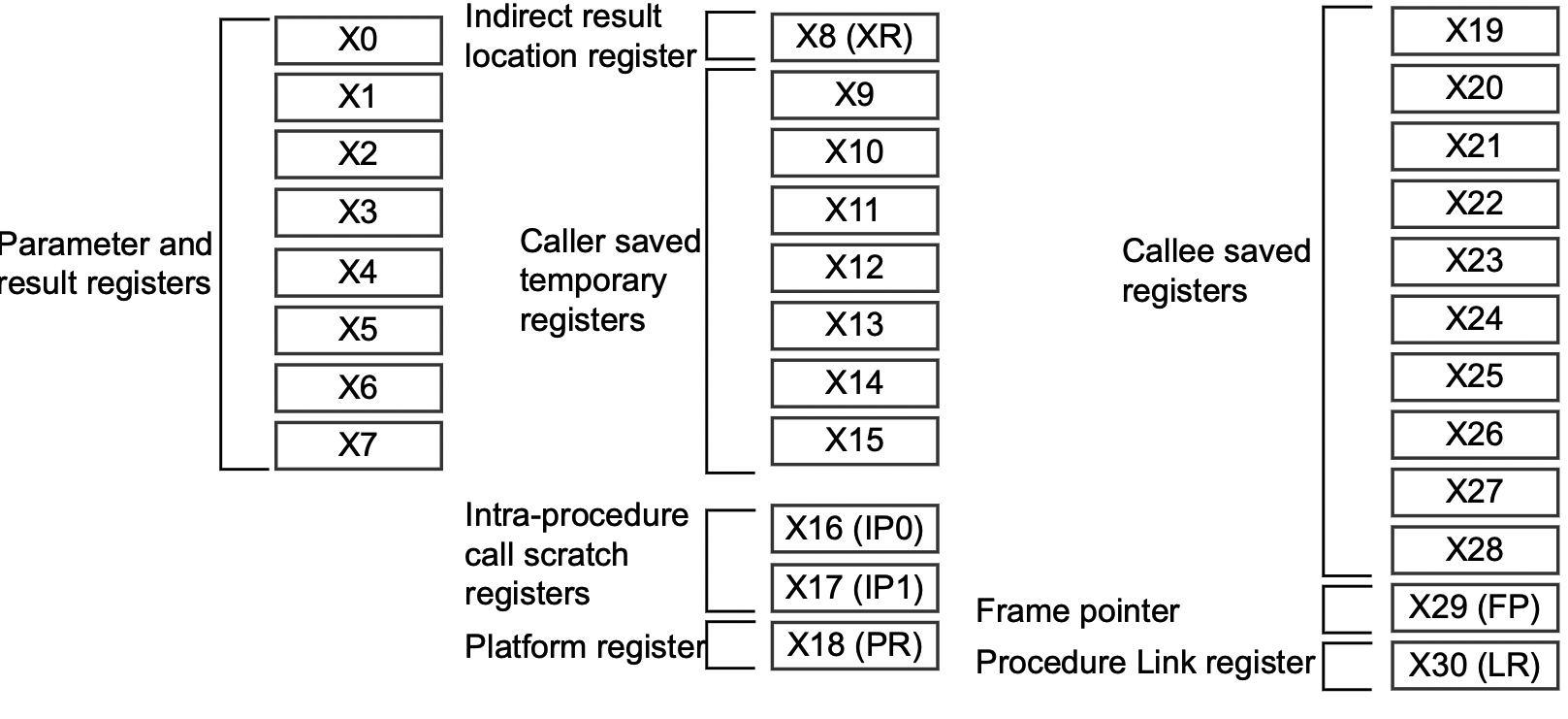
The above image is due to ARM and is found here.
What Does "Preserving" a Register Mean?
To backup (or "preserve") a register is copying the register onto the stack (i.e. storing a copy of the register in RAM). The str and stp instructions are used for this.
What Does "Restoring" a Register Mean?
To restore a register means copying a previously stored copy of the contents of a register from the stack (RAM) back to the register. The ldr and ldp instructions are used for this.
Always Manipulate the Stack in Multiples of 16
Any change you make to sp must be a multiple of 16.
Here is an example:
        .global main                                                    // 1
        .text                                                           // 2
        .align  2                                                       // 3
                                                                        // 4
main:   str     x30, [sp, -8]!                                          // 5
        ldr     x30, [sp], 8                                            // 6
        ret                                                             // 7
which produces:
regs > ./a.out
Bus error (core dumped)
regs >
Link Register
x30 is the Link Register, a register which is automatically used to store the return address when a function call is made (i.e. the bl instruction). Indeed, the bl instruction is called Branch with Link.
Nearly all functions have the implicit assumption that, at some point, they will return to whence they were called. Exceptions to this, of course, are functions like exit() and exec() family of functions.
Here's a fun program:
        .global main                                                    // 1
        .text                                                           // 2
        .align  2                                                       // 3
                                                                        // 4
main:   mov     x30, xzr                                                // 5
        ret                                                             // 6
                                                                        // 7
        .end                                                            // 8
regs > ./a.out
Segmentation fault (core dumped)
regs >
So short. So sweet. So lethal.
Manipulating the x30 register is done automatically by the bl and ret instructions.
The bl performs these steps:
- Compute the address of the instruction following the
bl - Put that address into
x30 - Put the address of the function being called into the Program Counter
Note that the Program Counter always contains the address of the next instruction to be executed. Loading a new value into the Program Counter causes a branch to take place. The Program Counter is a register but it is not one of the general purpose registers. Its mnemonic is pc.
The ret instruction copies the contents of x30 into the pc, causing a branch to that address (which ought to be where the function was called from).
The program above crashes because line 5 obliterates the address to which main() was supposed to return.
Exception to Needing to Protect x30
If your function:
- does not itself modify
x30and - does not itself call any other functions
then you do not need to backup and restore x30.
x0 through x7
These registers are truly scratch.
- You can modify them at any time
- You cannot count on their values surviving any function call you make
Note these registers are used to convey up to 8 parameters to functions.
x9 through x15
These registers are free for you to use but if you call other functions, you cannot count on them being what they were when a function returns. If you need these values to be preserved across function calls, you have to preserve them.
x19 through x28
These registers are free for you to use but if you modify them, you must preserve them.
x8, x16 through x18 and x29
While these registers are general purpose registers and you can use them, compilers use these to facilitate certain functions they do including easing the use of a debugger. If you're flitting back and forth from assembly language to higher level languages you might think about avoiding their use. x29 in particular is known as the frame pointer and is used for debugging. It will be explained in more detail elsewhere.
Restatement
| Registers | Preserve? |
|---|---|
x0...x7 |
All bets are off - no promised made |
x9...x15 |
If you are counting on their value across function calls, you must preserve them |
x19...x28 |
If you use them you must preserve them |