
4.6 KiB
Section 1 / Chapter 3 / While Loops
Overview
We have already covered the if statement. A while loop is exactly the same with the addition of at least one branch and a label. It really is that simple.
To illustrate this, here is a flow chart of an if statement (on the left) compared to a while loop (on the right).
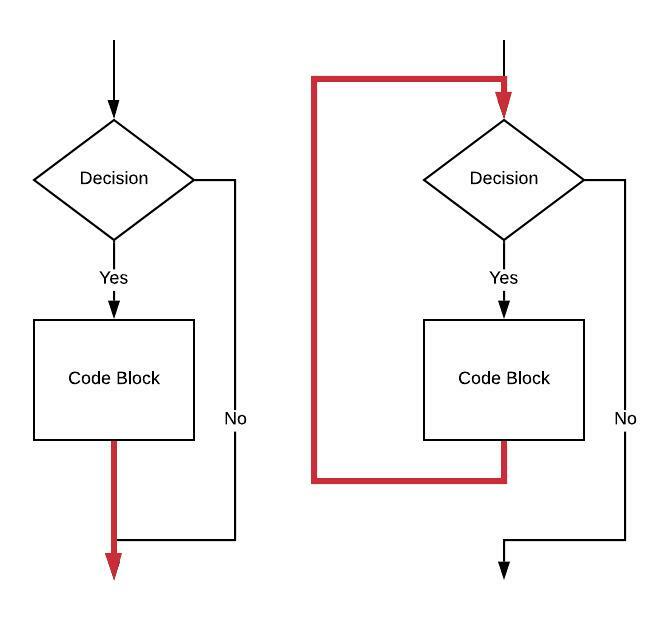
The closing brace in an if statement is indicated by the red arrow head. This isn't a branch, the code flow simply falls through to the statement beyond the closing brace. In the while loop, the behavior of the closing brace changes to be that of a branch back to just before the evaluation of the boolean condition (the "Decision").
A new label is placed before evaluating the "Decision".
A new unconditional branch is placed after the end of the "Code Block."
For review, consider this C or C++ code:
if (a >= b) {
	// CODE BLOCK
}
here is the assembly language for this if statement:
    // Assume value of a is in x0                                       // 1
    // Assume value of b is in x1                                       // 2
    cmp     x0, x1                                                      // 3
    ble     1f                                                          // 4
    // CODE BLOCK                                                       // 5
1:                                                                      // 6
Now, consider this while loop:
while (a >= b) {
	// CODE BLOCK
}
Here is the code for the while showing the addition of one new label and one new unconditional branch:
    // Assume value of a is in x0                                       // 1
    // Assume value of b is in x1                                       // 2
                                                                        // 3
 1: cmp     x0, x1                                                      // 4
    ble     2f                                                          // 5
    // CODE BLOCK                                                       // 6
    b       1b                                                          // 7
                                                                        // 8
2:                                                                      // 9
Temporary label 2 on line 9 takes the place of the line after the closing brace in a while loop.
Temporary label 1 on line 4 is the end point of the red arrow in the right hand
flow chart above.
Summary
A while loop is an extension of the if statement. A simple if contains one conditional branch and one label.
A while loop contains at least two labels, one conditional branch and one unconditional branch. We acknowledge the possibility that the unconditional branch could be made a conditional one, but this is rarely done in assembly language and impossible in higher level languages like C and C++ since the branch is simply the closing }.
Questions
1
(T | F) This code has a problem:
    // Assume value of a is in x0                                       // 1
    // Assume value of b is in x1                                       // 2
                                                                        // 3
 1: cmp     x0, x1                                                      // 4
    b       2f                                                          // 5
    // CODE BLOCK                                                       // 6
    b       1b                                                          // 7
                                                                        // 8
2:                                                                      // 9
Answer: True - the unconditional branch on line 5 doesn't reference the
results of the cmp that comes before it. The CODE BLOCK will never be
executed.
2
(T | F) This attempt at a while loop has a problem:
    // Assume value of a is in x0                                       // 1
    // Assume value of b is in x1                                       // 2
                                                                        // 3
 1: cmp     x0, x1                                                      // 4
    ble     2f                                                          // 5
    // CODE BLOCK                                                       // 6
                                                                        // 7
2:                                                                      // 8
Answer: True - missing a branch back to label 1, there is no loop.