
25 KiB
⬅ Index of all go-profiler-notes
The Busy Developers's Guide to Go Profiling, Tracing and Observability
- Introduction: Read This · Mental Model for Go · Profiling vs Tracing
- Use Cases: Reduce Costs · Reduce Latency · Memory Leaks · Program Hanging · Outages
- Go Profilers: CPU · Memory · Block · Mutex · Goroutine · ThreadCreate
- Viewing Profiles: Command Line · Flame Graph · Graph
- Go Execution Tracer: Timeline View · Derive Profiles
- Go Metrics: MemStats
- Other Tools: time · perf · bpftrace
- Advanced Topics: Assembly · Stack Traces · Little's Law
- Datadog Products: Continuous Profiler · APM (Distributed Tracing) · Metrics
🚧 This document is a work in progress. All sections above will become clickable links over time. The best way to find out about updates is to follow me and my thread on twitter where I'll announce new sections being added.
Introduction
Read This
This is a practical guide aimed at busy gophers interested in improving their programs using profiling, tracing and other observability techniques. If you're not well versed in the internals of Go, it is recommended that you read the entire introduction first. After that you should feel free to jump to any section you are interested in.
Mental Model for Go
It is possible to become quite proficient in writing Go code without understanding how the language works under the hood. But when it comes to performance and debugging, you'll hugely benefit from having a mental model of the internals. Therefore we'll begin with laying out a rudimentary model of Go below. This model should be good enough to allow you to avoid the most common mistakes, but all models are wrong, so you are encouraged to seek out more in-depth material to tackle harder problems in the future.
Go's primary job is to multiplex and abstract hardware resources, similar to an operating system. This is generally accomplished using two major abstractions:
- Goroutine Scheduler: Manages how your code is being executed on the CPUs of your system.
- Garbage Collector: Provides virtual memory that is automatically freed as needed.
Goroutine Scheduler
Let's talk about the scheduler first using the example below:
func main() {
    res, err := http.Get("https://example.org/")
    if err != nil {
        panic(err)
    }
    fmt.Printf("%d\n", res.StatusCode)
}
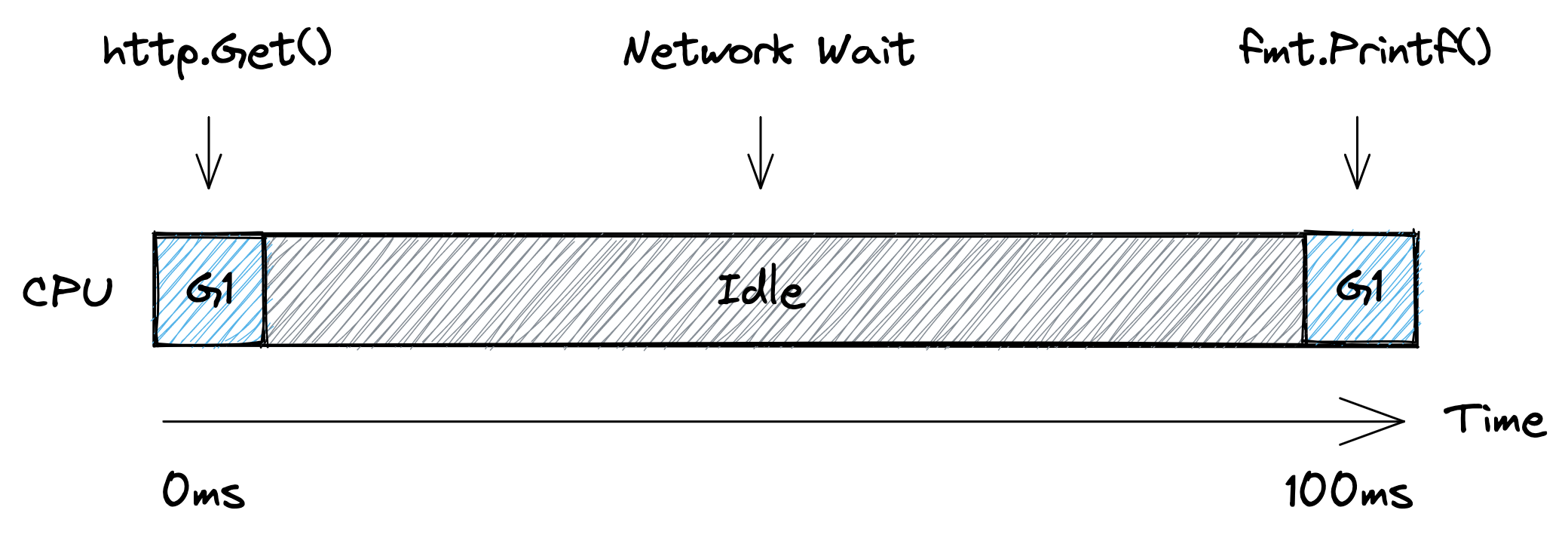
Here we have a single goroutine, let's call it G1, that runs the main function. The picture below shows a simplified timeline of how this goroutine might execute on a single CPU. Initially G1 is running on the CPU to prepare the http request. Then the CPU becomes idle as the goroutine has to wait for the network. And finally it gets scheduled onto the CPU again to print out the status code.
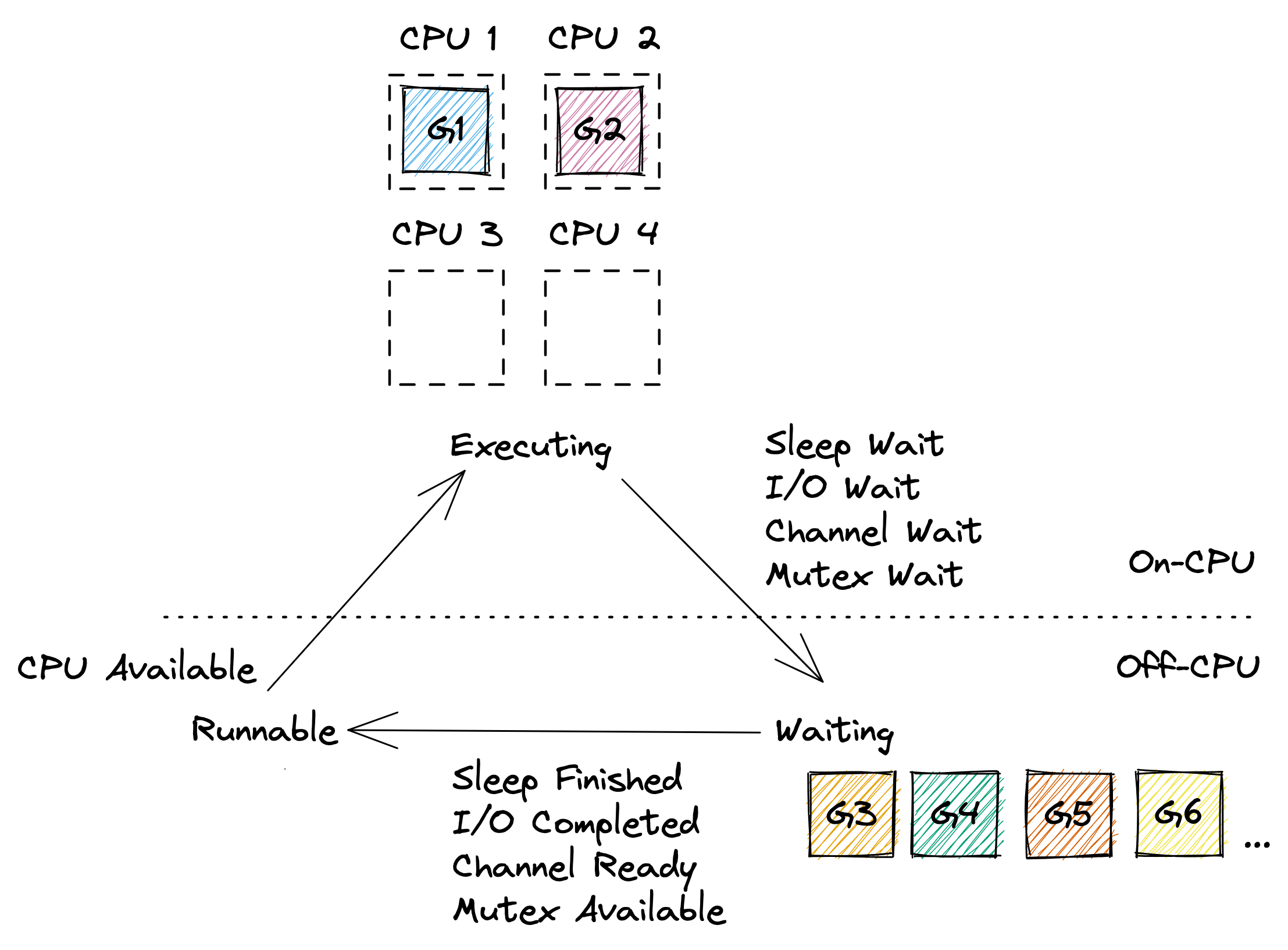
From the scheduler's perspective, the program above executes like shown below. At first G1 is Executing on CPU 1. Then the goroutine is taken off the CPU while Waiting for the network. Once the scheduler notices that the network has replied (using non-blocking I/O, similar to to Node.js), it marks the goroutine as Runnable. And as soon as a CPU core becomes available, the goroutine starts Executing again. In our case all cores are available, so G1 can go back to Executing the fmt.Printf() function on one of the CPUs immediately without spending any time in the Runnable state.
Most of the time, Go programs are running multiple goroutines, so you will have a few goroutines Executing on some of the CPU cores, a large number of goroutines Waiting for various reasons, and ideally no goroutines Runnable unless your program exhibits very high CPU load. An example of this can be seen below.
Of course the model above glosses over many details. In reality it's turtles all the way down, and the Go scheduler works on top of threads managed by the operating system, and even CPUs themselves are capable of hyper-threading which can be seen as a form of scheduling. So if you're interested, feel free to continue down this rabbit hole via Ardan labs series on Scheduling in Go or similar material.
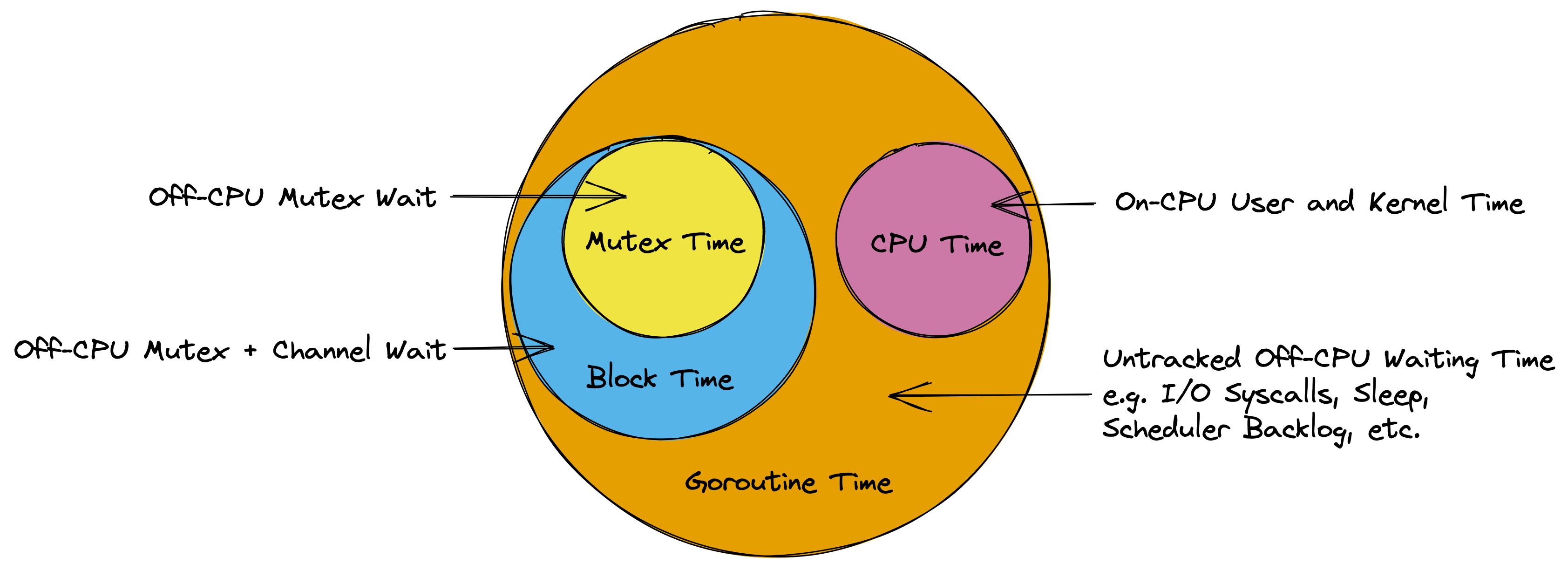
However, the model above should be sufficient to understand the remainder of this guide. In particular it should become clear that the time measured by the various Go profilers is essentially the time your goroutines are spending in the Executing and Waiting states as illustrated by the diagram below.
Garbage Collector
The other major abstraction in Go is the garbage collector. In languages like C, the programmer needs to manually deal with allocating and releasing memory using malloc() and free(). This offers great control, but turns out to be very error prone in practice. A garbage collector can reduce this burden, but the automatic management of memory can easily become a performance bottleneck. This section of the guide will present a simple model for Go's GC that should be useful for identifying and optimizing memory management related problems.
The Stack
Let's start with the basics. Go can allocate memory in one of two places, the stack or the heap. Each goroutine has its own stack which is a contiguous area of memory. Additionally there is a big area of memory shared between goroutines that is called the heap. This can be seen in the picture below.
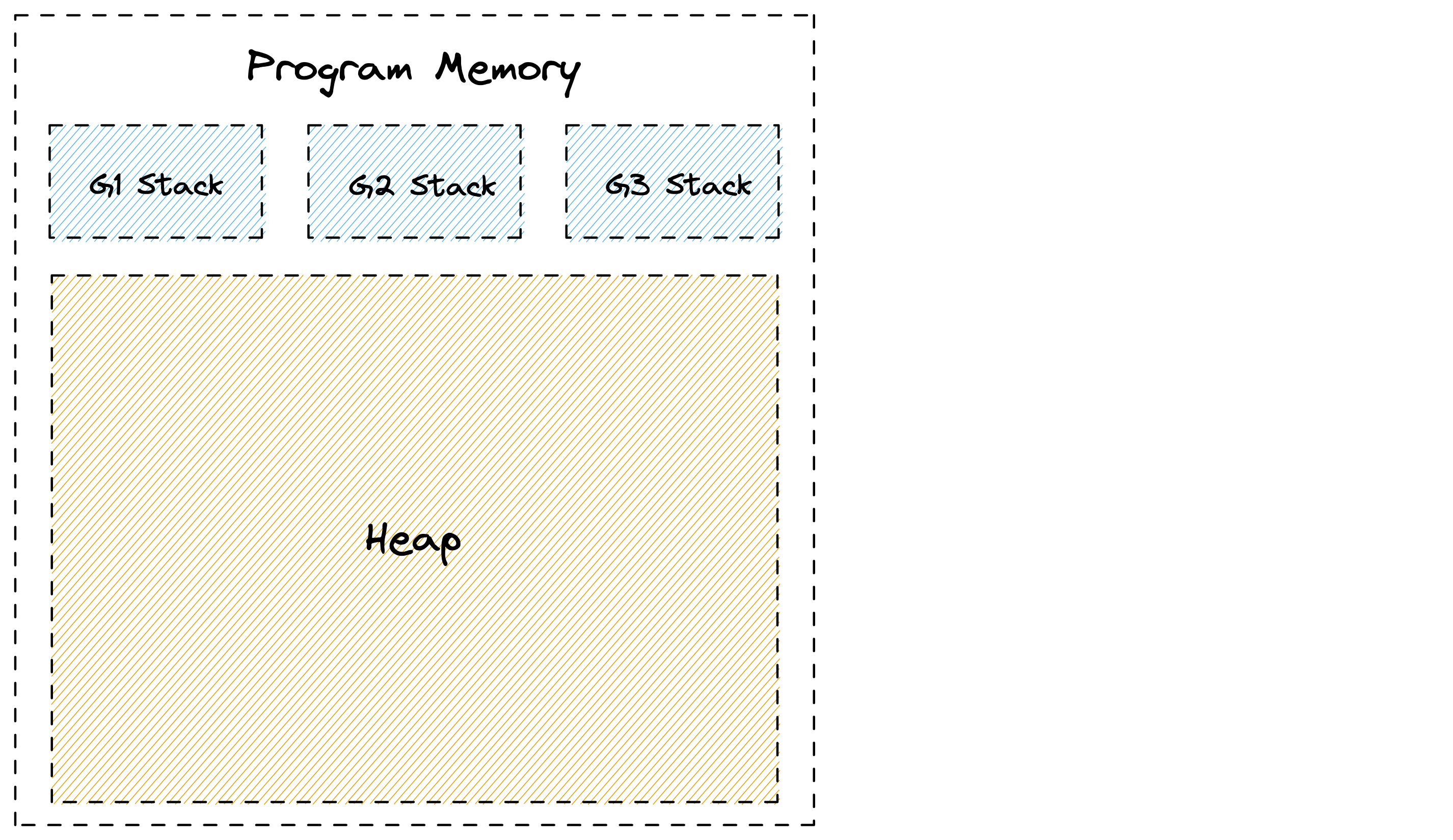
When a function calls another function it gets its own section on the stack called a stack frame where it can place things like local variables. A stack pointer is used to identify the next free spot in the frame. When a function returns, the data from the last frame is discarded by simply moving the stack pointer back to end of the previous frame. The frame's data itself can linger on the stack, and gets overwritten by the next function call. This is very simple and efficient as Go doesn't have to keep track of each variable.
To make this a little more intuitive, let's look at the example below:
func main() {
	sum := 0
	sum = add(23, 42)
	fmt.Println(sum)
}

func add(a, b int) int {
	return a + b
}
Here we have a main() function that starts out by reserving some space on the stack for the variable sum. When the add() function gets called, it gets its own frame to hold the local a and b parameters. Once the add() returns, its data is discarded by moving the stack pointer back to the end of the main() function's frame, and the sum variable gets updated with the result. Meanwhile the old values of add() linger beyond the stack pointer to be overwritten by the next function call. Below is a visualization of this process:
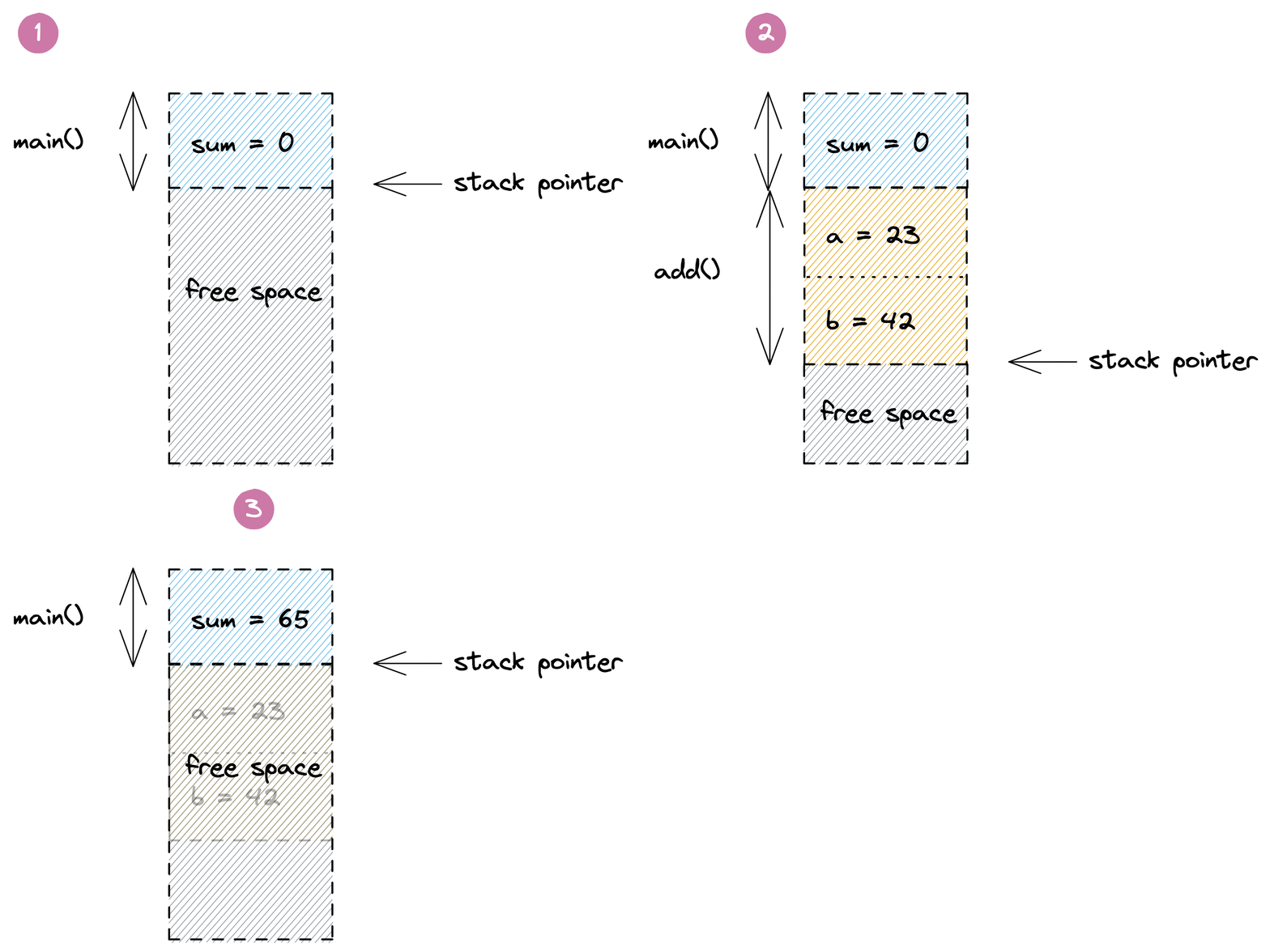
The example above is highly simplified and omits many details around return values, frame pointers, return addresses and function inlining. In fact, as of Go 1.17, the program above may not even need any space on the stack as the small amount of data can be managed using CPU registers by the compiler. But that's okay. This model should still give you a reasonable intuition for the way non-trivial Go programs allocate and discard local variables on the stack.
One thing you might wonder at this point is what happens if you run out of space on the stack. In languages like C this would cause a stack overflow error. Go on the other hand automatically deals with this problem by making a copy of the stack that's twice as big. This allows goroutines to start out with very small, typically 2 KiB stacks, and is one of the key ingredients for making goroutines more scalable than operating system threads.
Another aspect of the stack is how it's involved in creating stack traces. This is a bit more advanced, but if you're interested check out the Stack Traces in Go document in this repo.
The Heap
Stack allocations are great, but there are many situations where Go can't utilize them. The most common one is returning a pointer to a local variable of a function. This can be seen in this modified version of our add() example from above:
func main() {
	fmt.Println(*add(23, 42))
}

func add(a, b int) *int {
	sum := a + b
	return &sum
}
Normally Go would be able to allocate the sum variable inside of the add() function on the stack. But as we've learned, this data gets discarded when the add() function returns. So in order to safely return a &sum pointer, Go has to allocate the memory for it from outside of the stack. And that's where the heap comes in.
The heap is used for storing memory that might outlive the function that creates it, as well as for any data that is shared between goroutines using pointers. However, this raises the question of how this memory gets freed. Because unlike stack allocations, heap allocations can't be discarded when the function that created them returns.
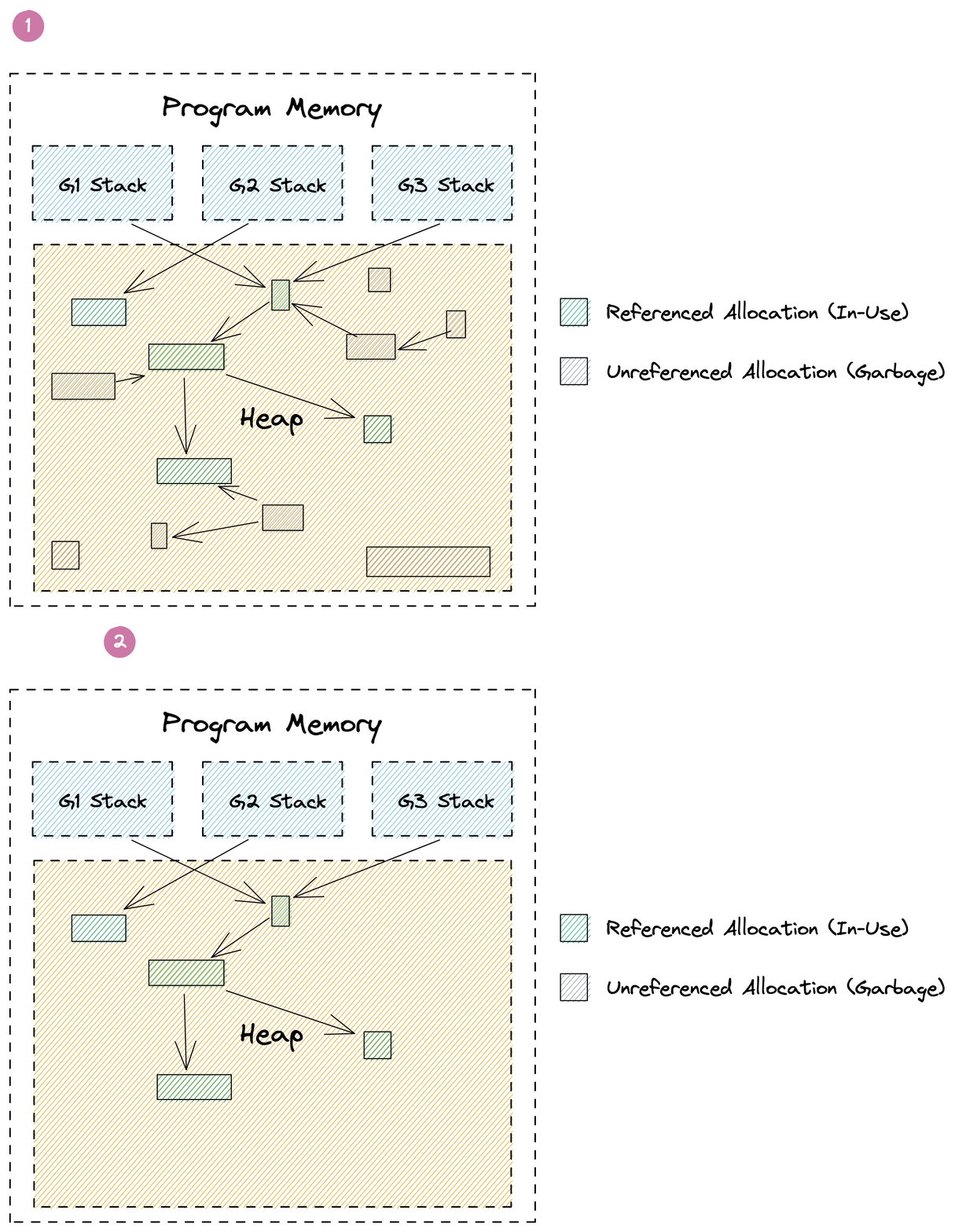
Go solves this problem using its built-in garbage collector. The details of its implementation are very complex, but from a birds eye view, it keeps track of your memory as shown in the picture below. Here you can see three goroutines that have pointers to green allocations on the heap. Some of these allocations also have pointers to other allocations shown in green. Additionally there are grey allocations that may point to the green allocations or each other, but they are not referenced by a green allocation themselves. Those allocations were once reachable, but are now considered to be garbage. This can happen if the function that allocated their pointers on the stack returned, or their value was overwritten. The GC is responsible for automatically identifying and freeing those allocations.
Performing GC involves a lot of expensive graph traversal and cache thrashing. It even requires regular stop-the-world phases that halt the execution of your entire program. Luckily recent versions of Go have gotten this down to fractions of a millisecond, but much of the remaining overhead is inherent to any GC. In fact, it's not uncommon that 20-30% of a Go program's execution are spend on memory management.
Generally speaking the cost of GC is proportional to the amount of heap allocations your program performs. So when it comes to optimizing the memory related overhead of your program, the mantra is:
- Reduce: Try to to turn heap allocations into stack allocations or avoid them alltogether. Minimizing the number of pointers on the heap also helps.
- Reuse: Reuse heap allocations rather than replacing them with new ones.
- Recycle: Some heap allocations can't be avoided. Let the GC recycle them and focus on other issues.
As with the previous mental model in this guide, everything above is an extremely simplified view of reality. But hopefully it will be good enough to make sense out of the remainder of this guide, and inspire you to read more articles on the subject. One article you should definitely read is Getting to Go: The Journey of Go's Garbage Collector which gives you a good idea of how Go's GC has advanced over the years, and the pace at which it is improving.
Go Profilers
CPU Profiler
Go's CPU profiler can help you identify which parts of your code base consume a lot of CPU time.
⚠️ Please note that CPU time is usually different from the real time experienced as latency by your users. For example a typical http request might take 100ms to complete, but only consume 5ms of CPU time while waiting for 95ms on a database. It's also possible for a request to take 100ms, but spend 200ms of CPU if two goroutines are performing CPU intensive work in parallel. If this is confusing to you, please refer to the Goroutine Scheduler section.
You can control the CPU profiler via various APIs:
go test -cpuprofile cpu.pprofwill run your tests and write a CPU profile to a file namedcpu.pprof.pprof.StartCPUProfile(w)captures a CPU profile towthat covers the time span untilpprof.StopCPUProfile()is called.import _ "net/http/pprof"allows you to request a 30s CPU profile by hitting theGET /debug/pprof/profile?seconds=30endpoint of the default http server that you can start viahttp.ListenAndServe("localhost:6060", nil).runtime.SetCPUProfileRate()lets you to control the sampling rate of the CPU profiler. See Known CPU Profiler Issues for current limitations.runtime.SetCgoTraceback()can be used to get stack traces into cgo code. benesch/cgosymbolizer has an implementation for Linux and macOS.
If you need a quick snippet to paste into your main() function, you can use the code below:
file, _ := os.Create("./cpu.pprof")
pprof.StartCPUProfile(file)
defer pprof.StopCPUProfile()
Regardless of how you activate the CPU profiler, the resulting profile will essentially be a table of stack traces formatted in the binary pprof format. A simplified version of such a table is shown below:
| stack trace | samples/count | cpu/nanoseconds |
|---|---|---|
| main;foo | 5 | 50000000 |
| main;foo;bar | 3 | 30000000 |
| main;foobar | 4 | 40000000 |
The CPU profiler captures this data by asking the operating system to monitor the CPU usage of the application and sends it a SIGPROF signal for every 10ms of CPU time it consumes. The OS also includes time consumed by the kernel on behalf of the application in this monitoring. Since the signal deliver rate depends on CPU consumption, it's dynamic and can be up to N * 100Hz where N is the number of logical CPU cores on the system. When a SIGPROF signal arrives, Go's signal handler captures a stack trace of the currently active goroutine, and increments the corresponding values in the profile. The cpu/nanoseconds value is currently directly derived from the sample count, so it is redundant, but convenient.
CPU Profiler Labels
A cool feature of Go's CPU profiler is that you can attach arbitrary key value pairs to a goroutine. These labels will be inherited by any goroutine spawned from that goroutine and show up in the resulting profile.
Let's consider the example below that does some CPU work() on behalf of a user. By using the pprof.Labels() and pprof.Do() API, we can associate the user with the goroutine that is executing the work() function. Additionally the labels are automatically inherited by any goroutine spawned within the same code block, for example the backgroundWork() goroutine.
func work(ctx context.Context, user string) {
	labels := pprof.Labels("user", user)
	pprof.Do(ctx, labels, func(_ context.Context) {
		go backgroundWork()
		directWork()
	})
}
The resulting profile will include a new label column and might look something like this:
| stack trace | label | samples/count | cpu/nanoseconds |
|---|---|---|---|
| main.childWork | user:bob | 5 | 50000000 |
| main.childWork | user:alice | 2 | 20000000 |
| main.work;main.directWork | user:bob | 4 | 40000000 |
| main.work;main.directWork | user:alice | 3 | 30000000 |
Viewing the same profile with pprof's Graph view will also include the labels:
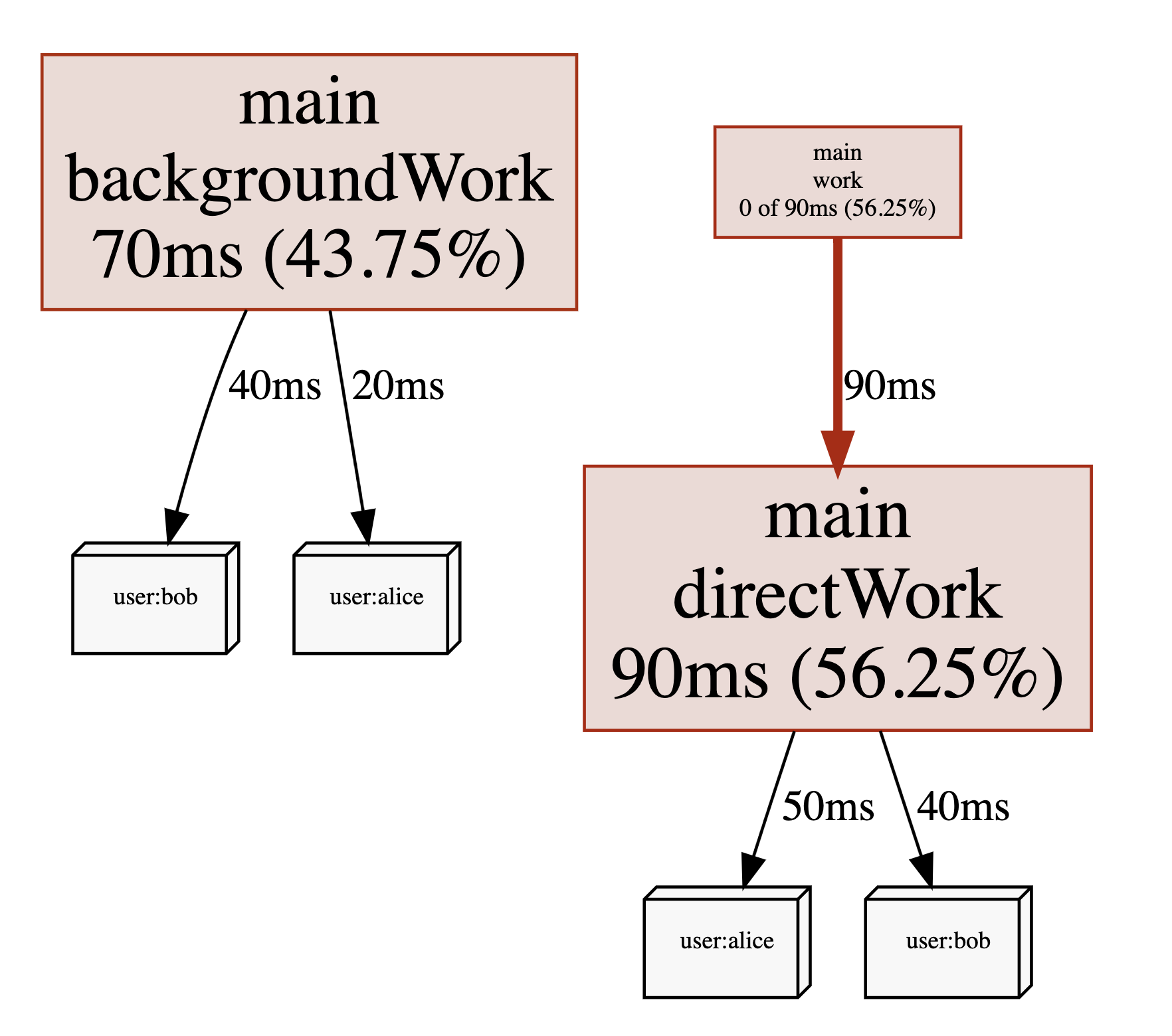
How you use these labels is up to you. You might include things such as user ids, request ids, http endpoints, subscription plan or other data that can allow you to get a better understanding of what types of requests are causing high CPU utilization, even when they are being processed by the same code paths. That being said, using labels will increase the size of your pprof files. So you should probably start with low cardinality labels such as endpoints before moving on to high cardinality labels once you feel confident that they don't impact the performance of your application.
CPU Utilization
Since the sample rate of the CPU profiler adapts to amount of CPU your program is consuming, you can derive the CPU utilization from CPU profiles. In fact pprof will do this automatically for you. For example the profile below was taking from a program that had an average CPU utilization of 147.77%:
$ go tool pprof guide/cpu-utilization.pprof
Type: cpu
Time: Sep 9, 2021 at 11:34pm (CEST)
Duration: 1.12s, Total samples = 1.65s (147.77%)
Entering interactive mode (type "help" for commands, "o" for options)
(pprof)
Another popular way to express CPU utilization is CPU cores. In the example above the program was using an average of 1.47 CPU cores during the profiling period.
⚠️ Due to one of the known issues below you shouldn't put too much trust in this number if it's near or higher than 250%. However, if you see a very low number such as 10% this usually indicates that CPU consumption is not an issue for your application. A common mistake is to ignore this number and start worrying about a particular function taking up a long time relative to the rest of the profile. This is usually a waste of time when overall CPU utilization is low, as not much can be gained from optimizing this function.
System Calls in CPU Profiles
If you see system calls such as syscall.Read() or syscall.Write() using a lot of time in your CPU profiles, please note that this is only the CPU time spend inside of these functions in the kernel. The I/O time itself is not being tracked. Spending a lot of time on system calls is usually a sign of making too many of them, so perhaps increasing buffer sizes can help. For more complicated situations like this, you should consider using Linux perf, as it can also show you kernel stack traces that might provide you with additional clues.
Known CPU Profiler Issues
There are a few known issues and limitations of the CPU profiler that you might want to be aware of:
- 🐞 A known issue on linux is that the CPU profiler struggles to achieve a sample rate beyond
250Hz. This is usually not a problem, but can lead to bias if your CPU utilization is very spiky. For more information on this, check out this GitHub issue. - ⚠️️ You can call
runtime.SetCPUProfileRate()to adjust the CPU profiler rate before callingruntime.StartCPUProfile(). This will print a warning sayingruntime: cannot set cpu profile rate until previous profile has finished. However, it still works within the limitation of the bug mentioned above. This issue was initially raised here, and there is an accepted proposal for improving the API. - ⚠️ The maximum number of nested function calls that can be captured in stack traces by the CPU profiler is currently hard coded to
64. If your program is using a lot of recursion or other patterns that lead to deep stack depths, your CPU profile will include stack traces that are truncated. This means you will miss parts of the call chain that led to the function that was active at the time the sample was taken.
Memory Profiler
Go's memory profiler can help you identify which parts of your code base perform a lot of heap allocations, as well as how many of these allocations were still reachable during the last garbage collection. Because of this, the profile produced by the memory profiler is also often referred to as a heap profile.
Heap memory management related activities are often responsible for up to 20-30% of CPU time consumed by Go processes. Additionally the elimination of heap allocations can have second order effects that speed up other parts of your code due to decreasing the amount of cache thrashing that occurs when the garbage collector has to scan the heap. This means that optimizing memory allocations can often have a better return on investment than optimizing CPU-bound code paths in your program.
⚠️ The memory profiler does not show stack allocations as these are generally much cheaper than heap allocations. Please refer to the Garbage Collector section for more details.
You can enable the memory profiler via various APIs:
go test -memprofile mem.pprofwill run your tests and write a memory profile to a file namedmem.pprof.pprof.Lookup("heap").WriteTo(w, 0)writes a memory profile that covers the time since the start of the process tow.import _ "net/http/pprof"allows you to request a 30s memory profile by hitting theGET /debug/pprof/heap?seconds=30endpoint of the default http server that you can start viahttp.ListenAndServe("localhost:6060", nil). This is also called a delta profile internally.runtime.MemProfileRatelets you to control the sampling rate of the memory profiler. See Known Memory Profiler Issues for current limitations.
If you need a quick snippet to paste into your main() function, you can use the code below:
file, _ := os.Create("./mem.pprof")
defer pprof.Lookup("heap").WriteTo(file, 0)
Regardless of how you activate the Memory profiler, the resulting profile will essentially be a table of stack traces formatted in the binary pprof format. A simplified version of such a table is shown below:
| stack trace | alloc_objects/count | alloc_space/bytes | inuse_objects/count | inuse_space/bytes |
|---|---|---|---|---|
| main;foo | 5 | 120 | 2 | 48 |
| main;foo;bar | 3 | 768 | 0 | 0 |
| main;foobar | 4 | 512 | 1 | 128 |
The memory profile contains two major pieces of information:
alloc_*: The amount of allocations that your program has made since the start of the process (or profiling period for delta profiles).insue_*: The amount of allocations that your program has made that were still reachable during the last GC.
func malloc(size):
  object = ... // alloc magic

  if poisson_sample(size):
    s = stacktrace()
    profile[s].allocs++
    profile[s].alloc_bytes += sizeof(object)
    track_profiled(object, s)

  return object

func sweep(object):
  // do gc stuff to free object

  if is_profiled(object)
    s = alloc_stacktrace(object)
    profile[s].frees++
    profile[s].free_bytes += sizeof(object)

  return object
Memory Inuse vs RSS
Known Memory Profiler Issues
- ⚠️
runtime.MemProfileRatemust be should only be modified once as early as possible in the startup of the program, for example at the beginning ofmain(). Writing this value is inherently a small data race, and changing it multiple times during program execution will produce incorrect profiles. - ⚠ The memory profiler does not support labels like the CPU Profiler Labels. It's difficult to add this feature to the current implementation as it could create a memory leak in the internal hash map that holds the memory profiling data.
- ⚠ The memory profiler does not show heap allocations made by cgo C code.
ThreadCreate Profiler
🐞 The threadcreate profile is intended to show stack traces that led to the creation of new OS threads. However, it's been broken since 2013, so you should stay away from it.
Disclaimers
I'm felixge and work at Datadog on Continuous Profiling for Go. You should check it out. We're also hiring : ).
The information on this page is believed to be correct, but no warranty is provided. Feedback is welcome!